
Paediatric Dentistry
Paediatric Dentistry
For children, dental visits should begin when the first tooth appears, not when pain starts. International paediatric dentistry associations recommend the first examination within six months of the first baby tooth erupting and by the age of one at the latest. Early check-ups allow preventive measures to be taken before decay develops and help the child build a positive relationship with the clinic.
Medical review: Taylan Akca, DDS, PhD — Oral and Maxillofacial Surgeon. Last updated: Nov. 15, 2026.
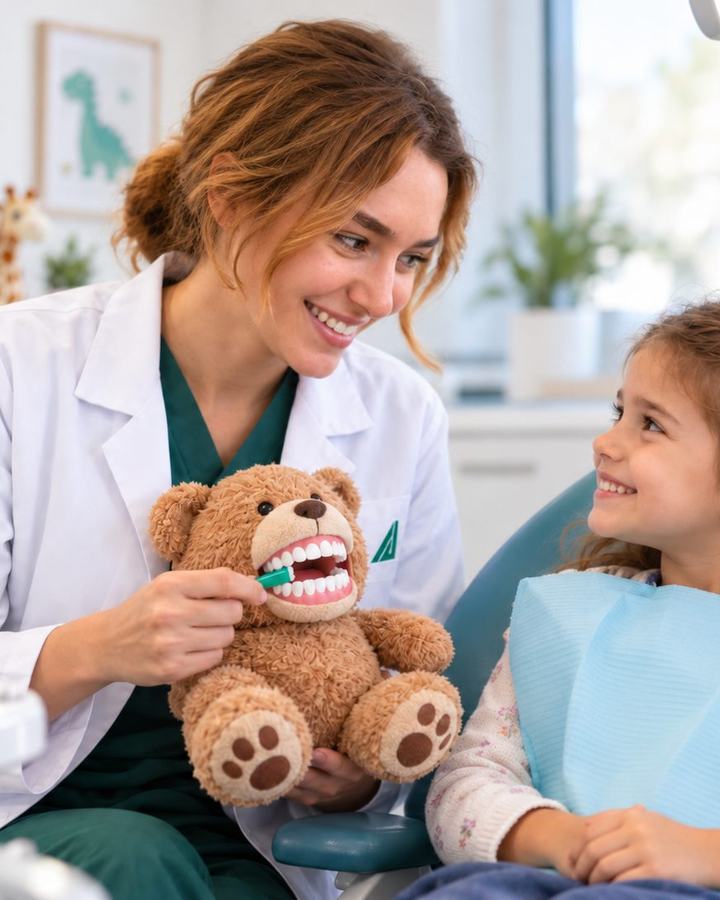
When and how should the first visit happen?
The American Academy of Pediatric Dentistry (AAPD) recommends a first assessment around the age of one. This visit is usually just a short chat and examination: the condition of the baby teeth, decay risk, feeding and bottle habits, brushing technique and the amount of toothpaste to use are discussed. The aim is for the child's first dental experience to be painless and calm.
Why are baby teeth important?
Baby teeth are needed for eating, speech and jaw development, and they hold space for the permanent teeth coming through underneath. A baby tooth lost early can let neighbouring teeth drift and close the path for the permanent tooth to erupt. Decayed baby teeth can cause pain, infection and problems with sleep and eating.
Home care: recommendations by age
According to the European Academy of Paediatric Dentistry's 2019 fluoride guideline:
| Age | Fluoride in toothpaste | Amount | Brushing |
|---|---|---|---|
| From the first tooth to age 2 | 1000 ppm | A grain-of-rice smear | Twice a day, brushed by a parent |
| Ages 2–6 | 1000 ppm | A pea-sized amount | Twice a day, brushed or helped by a parent |
| Age 6 and over | 1450 ppm | 1–2 cm | Twice a day, supervised by a parent until at least age 7 |
After brushing, do not rinse heavily with water; spit out the excess toothpaste. Brushing at night is especially important. How often sugary foods and drinks are consumed matters more for decay risk than how much; giving milk or juice in a bottle at night markedly increases the risk of decay.
Preventive treatments
- Fluoride varnish: a high-fluoride protective coating painted on the teeth in the clinic. It can be applied several times a year in children at high risk of decay.
- Fissure sealants: the deep grooves on the chewing surfaces of molars are sealed with a thin resin. According to a Cochrane review, in a population where decay develops within two years on 40% of tooth surfaces without sealants, sealants reduce this to about 6%. They are usually applied soon after the permanent molars erupt (around ages 6 and 12).
- Diet and habit counselling: bottle, dummy and thumb-sucking habits are assessed.
Treatments for baby teeth
When decay is caught early, preventive treatment and monitoring are sometimes enough. For more advanced decay, fillings; for decay that has reached the pulp, pulp treatments specific to baby teeth (pulpotomy); and for badly broken-down teeth, children's crowns may be used. A space maintainer may be needed to hold the space of a baby tooth lost early. The choice of treatment depends on how long the tooth needs to stay in the mouth and on the child's cooperation.
First aid for dental injuries
- If a permanent tooth is knocked out completely: hold the tooth by the crown, not the root. If it is dirty, rinse it briefly under cold water (do not scrub it). If possible, put it back in its socket straight away; if you cannot, carry it in milk or in saliva spat into a small container and see a dentist immediately. Time is critical.
- If a baby tooth is knocked out: it is not put back, as the permanent tooth bud underneath may be damaged. An examination is still needed.
- If a tooth is broken: keep the broken fragment moist; in some cases it can be bonded back on.
Frequently asked questions
When should the first dental visit be?
Within six months of the first baby tooth appearing, and by the age of one at the latest.
Can I use fluoride toothpaste for my baby?
Yes. The European guideline recommends a grain-of-rice amount of 1000 ppm fluoride toothpaste from the first tooth. Getting the amount right is important.
Is fluoride treatment safe?
Topical fluoride applied by a dentist at a dose appropriate to age and risk is safe and effective in preventing decay. Unnecessary or uncontrolled use is not recommended.
Baby teeth will fall out anyway — do they need treatment?
Yes. Some baby molars stay in the mouth until age 10–12. Untreated decay can lead to pain, infection and problems with the permanent tooth.
How long do fissure sealants last?
The sealant is checked at check-ups; if worn or partly lost, it can be renewed.
My child grinds their teeth at night — is that a problem?
Tooth grinding is common in children and often needs no treatment. Assessment is needed if it comes with sleep-related problems (snoring, mouth breathing).
When is the first orthodontic check-up?
When a problem is noticed, or by age 7 at the latest. Not every child needs active treatment at an early age.
References
- American Academy of Pediatric Dentistry — summary of the first-visit recommendation: Sanchez OM, Childers NK. Anticipatory guidance in infant oral health: rationale and recommendations (summary of the AAPD recommendation). Am Fam Physician. 2000;61(1):115. aafp.org
- Toumba KJ, Twetman S, Splieth C et al. Guidelines on the use of fluoride for caries prevention in children: an updated EAPD policy document. Eur Arch Paediatr Dent. 2019;20(6):507–516. doi:10.1007/s40368-019-00464-2
- Ahovuo-Saloranta A, Forss H, Walsh T et al. Pit and fissure sealants for preventing dental decay in permanent teeth. Cochrane Database Syst Rev. 2017;7:CD001830. doi:10.1002/14651858.CD001830.pub5
- Fouad AF, Abbott PV, Tsilingaridis G et al. International Association of Dental Traumatology guidelines for the management of traumatic dental injuries: 2. Avulsion of permanent teeth. Dent Traumatol. 2020;36(4):331–342. doi:10.1111/edt.12573
- American Association of Orthodontists — first orthodontic check-up. aaoinfo.org
Treatment duration
The first visit is kept short and usually consists only of an examination and getting to know each other. Check-up frequency is usually set at every 6–12 months depending on the child's decay risk and stage of development. When treatment is needed, sessions are kept short to maintain the child's cooperation.
Points to consider
Fluoride is applied with a dose and method appropriate to age and decay risk; supplements such as fluoride tablets should not be used without a dentist's recommendation. For very young children who need extensive treatment or who cannot cooperate with treatment, sedation or general anaesthesia options can be considered at appropriate centres. Tell us about any medications your child takes and their health at the examination.