
Implants and Oral Surgery
Implant Treatment in Full Edentulism
In some situations where all teeth have been lost, or where it is not possible to preserve the remaining teeth in the long term, implant-supported prostheses may be assessed.
Medical review: Dr. Taylan Akça. Last updated: Aug. 29, 2026.
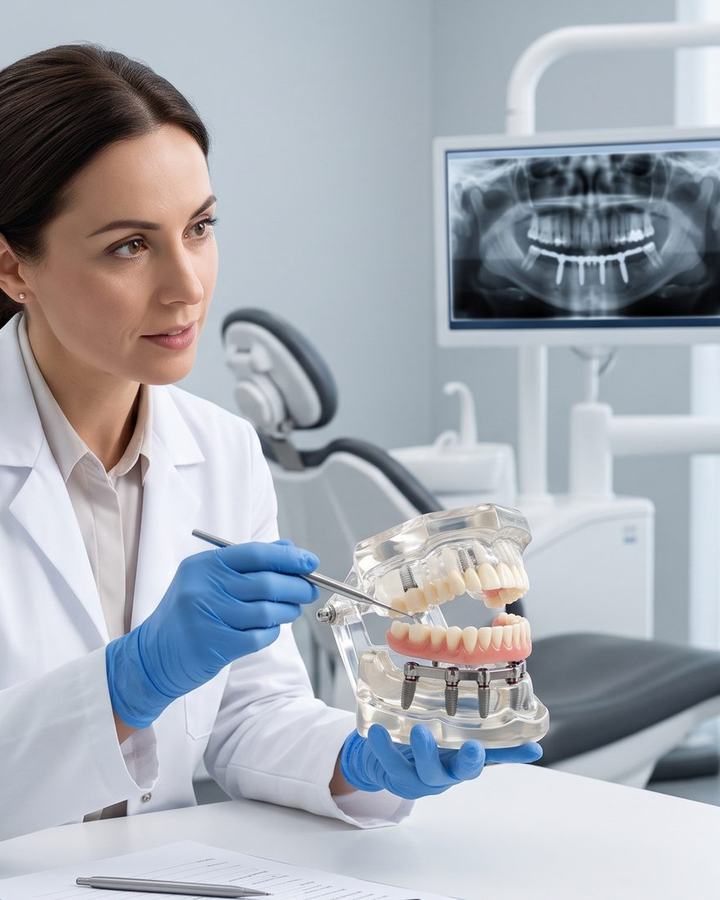
What is the focus of the plan?
In these plans the aim is not only to answer the question of "how many implants". Bone volume and distribution, anatomical structures, jaw relationships, cleansability, lip and tooth support, speech and the patient's expectations are all considered together.
Fixed and removable options
Fixed implant-supported prostheses are not removed by the patient day to day. With implant-supported removable prostheses the prosthesis can be removed by the patient; the implants increase the retention of the prosthesis. The two approaches differ in their advantages, care requirements and cost structure.
What do All-on-4 / All-on-6 mean?
These terms are used to describe treatment concepts in which full-arch prostheses are planned on a specific number of implants. However, a standard "4" or "6" implants is not correct for every fully edentulous patient. The number and position of implants should be planned for the individual case.
Is treatment possible without going without teeth?
In suitable cases a fixed temporary prosthesis may be planned on implants that have achieved sufficient stability, on the same day or within a short time. This prosthesis is not the definitive prosthesis and needs to be used in a controlled way during the healing period. In unsuitable cases it may be safer for the implants to heal without being loaded.
Frequently asked questions
How many implants are needed in a fully edentulous jaw?
A single number cannot be applied to every patient. The goal of a fixed or removable prosthesis, the bone, anatomical limits, implant distribution and prosthesis design are all assessed together.
Is All-on-4 suitable for everyone?
No. It is a treatment concept that can be used under certain anatomical and prosthetic conditions. In some patients more implants or a different plan may be preferred.
Can fixed teeth be fitted on the day the implants are placed?
In some suitable cases a temporary fixed prosthesis may be made. This decision is taken by assessing the primary stability of the implants, the bone, the bite and other risk factors.
Why are the permanent teeth not made straight away?
Changes can occur in the gum and bone tissues during the healing period. It may be preferred for the definitive prosthesis to be prepared, after these changes, with a more accurate tissue fit and design.
How is a full-arch implant prosthesis cleaned?
Depending on the prosthesis design, special interdental brushes, superfloss, an oral irrigator and professional care may be needed. Cleansability should be considered at the start of the treatment plan.
Treatment duration
The duration of the surgical and prosthetic stages varies with the case, the bone and the loading protocol. In suitable cases a temporary fixed prosthesis may be planned in the early period; the definitive prosthesis is most often prepared after healing.
When it may not be suitable
Suitability is determined by an individual examination. Situations such as uncontrolled systemic disease, certain medications, active infection, inadequate oral hygiene or a history of radiotherapy to the head and neck region may affect the plan.