
Tooth and Gum Health
Root Canal Treatment / Endodontics
Inside the tooth is a soft tissue called the "pulp", which contains blood vessels and nerves. If the pulp becomes irreversibly inflamed or infected, root canal treatment removes this tissue, disinfects and fills the canals, and keeps the tooth in the mouth. Scientific studies report that the large majority of root-canal-treated teeth are still functioning in the mouth after 8–10 years.
Medical review: Taylan Akca, DDS, PhD — Oral and Maxillofacial Surgeon. Last updated: Nov. 15, 2026.
What is root canal treatment?
After deep decay, cracks, large old fillings or trauma, bacteria can reach the pulp. Once the pulp is irreversibly inflamed it cannot repair itself; if left untreated, infection can spread to the bone around the root tip. In root canal treatment our aim is to clean out the infected tissue, seal the tooth so that bacteria cannot re-enter, and preserve the natural tooth.
Which symptoms may indicate the need for root canal treatment?
- Pain triggered by hot or cold that lingers after the stimulus is removed
- Pain that starts on its own, especially pain that wakes you at night
- Pain when chewing or when the tooth is touched
- A pimple-like swelling on the gum that drains from time to time (fistula)
- Swelling of the face or gum
- Darkening of the tooth
Some teeth have no symptoms at all; infection at the root tip is found on a routine X-ray. Conversely, not every painful tooth needs root canal treatment.
Does every painful tooth need root canal treatment?
No. Brief sensitivity that disappears when the stimulus is removed often indicates that the pulp can still heal; it may resolve once the decay is removed and a filling placed. The European Society of Endodontology (ESE) 2023 guideline recommends selective or stepwise caries removal in deep decay without exposing the pulp and, in suitable cases, treatments aimed at preserving the living part of the pulp (pulp capping, pulpotomy). The appropriate approach is decided by examination, vitality tests and X-rays.
How is treatment done step by step?
- Diagnosis. Your symptoms are discussed, cold and percussion tests are done on the tooth and an X-ray is taken. Three-dimensional imaging (CBCT) may be requested if needed.
- Anaesthesia. The procedure is done under local anaesthetic.
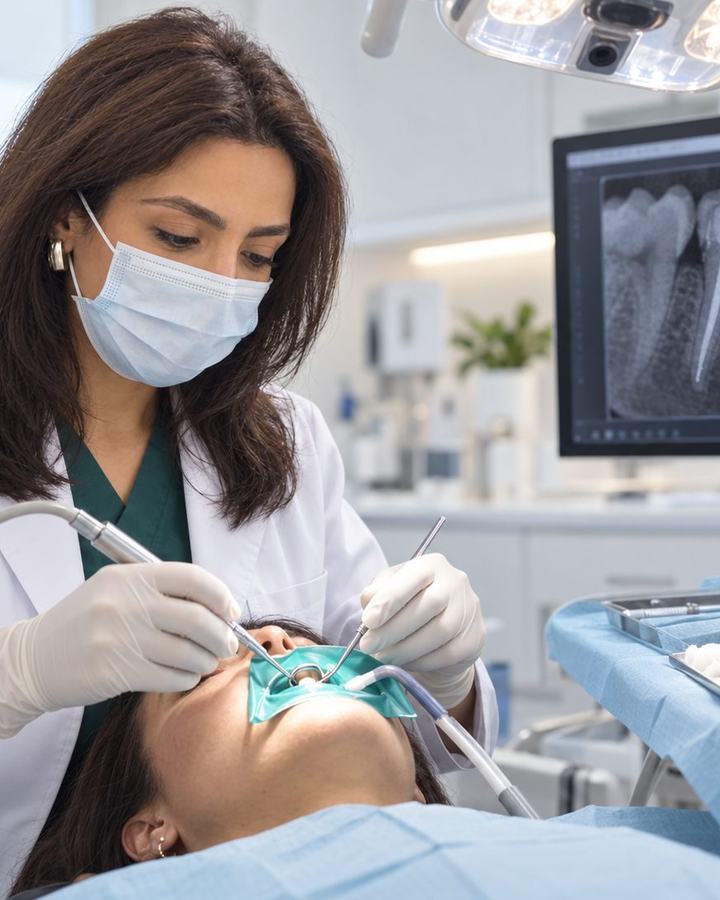
- Isolation. The tooth is isolated with a thin rubber sheet (rubber dam) to protect it from saliva and bacteria.
- Access and cleaning. The canals are reached through a small opening in the top of the tooth. Canal length is determined with an electronic measuring device and X-rays; the canals are shaped with special instruments and irrigated with disinfecting solutions.
- Interim visit (if needed). If infection is extensive, an antibacterial medicament may be placed in the canals for a period and the tooth temporarily sealed.
- Filling. The cleaned canals are filled and sealed with a biocompatible filling material.
- Permanent restoration. The top of the tooth is permanently sealed with a filling, onlay or crown. This step is as important for success as the root filling; you should not wait long with a temporary filling.
How successful is root canal treatment?
In a systematic review of the long-term outcome of treated teeth, tooth survival (staying in the mouth) was 86% at 2–3 years, 93% at 4–5 years and 87% at 8–10 years. The factors that most affect the outcome are whether there was inflammation at the root tip before treatment, whether the canals could be cleaned and filled to their full length, and how well the top of the tooth is sealed. These figures are averages from research, not a guarantee; each tooth's situation is assessed individually.
What should I watch for after treatment?
- Some tenderness when biting may be expected for the first 2–3 days; it usually settles with simple painkillers.
- Do not chew hard food on that side until the permanent restoration is placed.
- Do not eat until the numbness has worn off (you may bite your lip or cheek).
- Contact the clinic if pain gets steadily worse, or if you develop facial swelling or fever.
- Bone healing around the root tip can take months; a check-up X-ray is usually taken after 6–12 months.
What happens if root canal treatment fails?
If symptoms persist or the X-ray shows no healing, three options are considered: redoing the root canal treatment, surgery at the root tip (apicoectomy), or extracting the tooth and replacing it with an implant or bridge. The choice depends on the remaining sound tooth structure, whether the root is cracked and the patient's preference.
Frequently asked questions
Is root canal treatment painful?
The procedure is done under local anaesthetic and the aim is pain control throughout. In fact, root canal treatment is done to eliminate the pain caused by an inflamed pulp. There may be mild tenderness for a few days afterwards.
Does a root-canal-treated tooth become "dead"?
The nerve tissue inside the tooth is removed, but the tooth remains within living tissues through its connection to the surrounding bone and gum and continues to function.
Can antibiotics replace root canal treatment?
No. The European Society of Endodontology guideline states that antibiotics are not effective for toothache caused by pulp inflammation and should not be used. Antibiotics are considered only in addition to treatment in selected situations, such as infection spreading to the face or accompanied by fever.
Does every root-canal-treated tooth need a crown?
No. A filling is often enough for front teeth. In back teeth, especially where a lot of structure has been lost, a restoration that covers the cusps (onlay or crown) protects the tooth against fracture.
Why does a root-canal-treated tooth darken?
Breakdown of pulp tissue or some materials can cause discolouration of the tooth over time. This can be corrected with internal whitening or restorative methods.
Can root canal treatment be done during pregnancy?
Pain and infection should not be left untreated. During pregnancy, root canal treatment can be done with the necessary precautions, preferably in the second trimester. Always tell us if you are or might be pregnant.
Root canal treatment or extraction and an implant?
Preserving the natural tooth is usually the first choice for a tooth that can be saved. If the long-term prognosis of root canal treatment is poor, implant or bridge options are considered together.
Related pages
- Zirconia and Porcelain Crowns
- Dental Radiology / CBCT
- Dental Implants
- Paediatric Dentistry (pulp treatments in baby teeth)
References
- Duncan HF, Kirkevang LL, Peters OA et al. Treatment of pulpal and apical disease: The European Society of Endodontology (ESE) S3-level clinical practice guideline. Int Endod J. 2023;56(Suppl 3):238–295. doi:10.1111/iej.13974
- Ng YL, Mann V, Gulabivala K. Tooth survival following non-surgical root canal treatment: a systematic review of the literature. Int Endod J. 2010;43(3):171–189. doi:10.1111/j.1365-2591.2009.01671.x
- Ng YL, Mann V, Gulabivala K. A prospective study of the factors affecting outcomes of non-surgical root canal treatment: part 2: tooth survival. Int Endod J. 2011;44:610–625. doi:10.1111/j.1365-2591.2011.01873.x
- Manfredi M, Figini L, Gagliani M, Lodi G. Single versus multiple visits for endodontic treatment of permanent teeth. Cochrane Database Syst Rev. 2016;12:CD005296. doi:10.1002/14651858.CD005296.pub3
- Ruggiero SL, Dodson TB, Aghaloo T et al. AAOMS position paper on medication-related osteonecrosis of the jaws — 2022 update. J Oral Maxillofac Surg. 2022;80(5):920–943. doi:10.1016/j.joms.2022.02.008
Treatment duration
Depending on the tooth's anatomy and the extent of infection, root canal treatment is usually completed in 1 or 2 sessions; a single session usually lasts 45–90 minutes. In suitable cases, single- and multiple-visit treatment have been shown to give similar results. The permanent restoration is placed in the same session or shortly afterwards. Healing is assessed with a check-up X-ray after 6–12 months.
Who may not be suitable
In teeth with a vertical root fracture, teeth that have lost too much structure to be saved, or teeth that have lost their support because of advanced gum disease, the long-term chance of success of root canal treatment is low; other options are discussed in these situations. Conversely, in people taking certain medications against bone loss (antiresorptive therapy) or who have had radiotherapy to the head and neck, root canal treatment may be the safer option because of the risks of extraction. Always tell your dentist about the medications you take.