
Implants and Oral Surgery
Wisdom Teeth and Impacted Teeth
Wisdom teeth are the third molars at the very back of the jaw. Not every wisdom tooth needs to be extracted; teeth that have erupted healthily, can be cleaned and do not harm the surrounding tissues may be monitored.
Medical review: Dr. Taylan Akça. Last updated: Aug. 29, 2026.
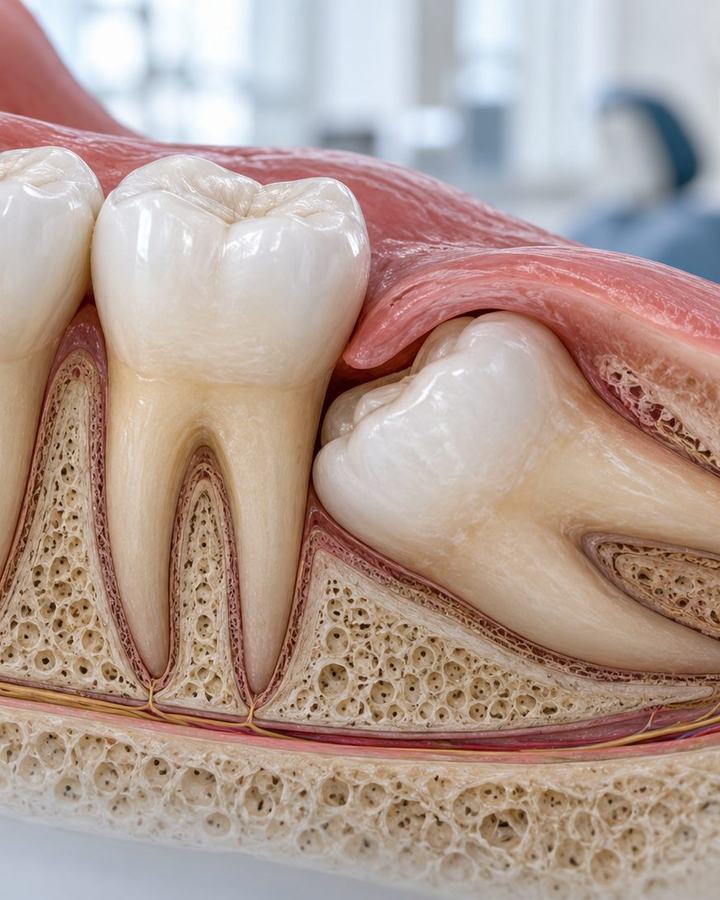
In which situations may extraction be considered?
- Recurrent infection / pericoronitis
- Decay or root damage in the neighbouring tooth
- A partly impacted position that cannot be cleaned
- Suspicion of a cyst or other pathological formation
- Selected situations required by the orthodontic or surgical plan
A wisdom tooth close to the nerve
The roots of some lower wisdom teeth can be close to the mandibular canal. If a panoramic film suggests proximity, three-dimensional CBCT may be requested. The surgical method and the risk of possible nerve damage are assessed for the individual case.
Healing
Swelling and pain can vary with the difficulty of the operation. In the first few days it is important to follow the advice on bleeding control, nutrition, oral hygiene, smoking and physical activity. Unexpected severe pain, excessive bleeding, high fever, difficulty breathing or swallowing, or newly developing marked loss of sensation should be reported to the clinic.
Frequently asked questions
Should every wisdom tooth be extracted?
No. Healthy wisdom teeth that can be cleaned and do not cause problems may be monitored.
If an impacted tooth causes no pain at all, should it be extracted?
The absence of pain alone does not settle the decision. The neighbouring tooth, the risk of a cyst, cleansability and radiographic findings are assessed.
How long does the operation take?
It varies with the position of the tooth. A simple extraction may be short, while deeply impacted or anatomically difficult cases may take longer.
How many days does the swelling last?
It is generally expected to increase over the first few days and then subside; it varies with the person and the difficulty of the procedure.
When are the sutures removed?
Depending on the suture material used, there may be self-dissolving sutures or sutures removed at a review appointment.
Treatment duration
The operation time varies with the position of the tooth; a simple extraction may be short, while deeply impacted or anatomically difficult cases may take longer. Healing generally progresses noticeably within the first week.
When it may not be suitable
The decision to extract is not reduced to whether or not there is pain; the condition of the neighbouring tooth, the risk of a cyst, cleansability and radiographic findings are assessed together. For roots close to the nerve, additional assessment with CBCT may be carried out.