
Implants and Oral Surgery
Immediate / Early Loading
"Immediat (immediate) loading" means attaching a temporary prosthesis to an implant a very short time after it is placed; "immediat implant" means placing the implant in the same session as the tooth extraction. The two concepts are not the same.
Medical review: Dr. Taylan Akça. Last updated: Aug. 29, 2026.
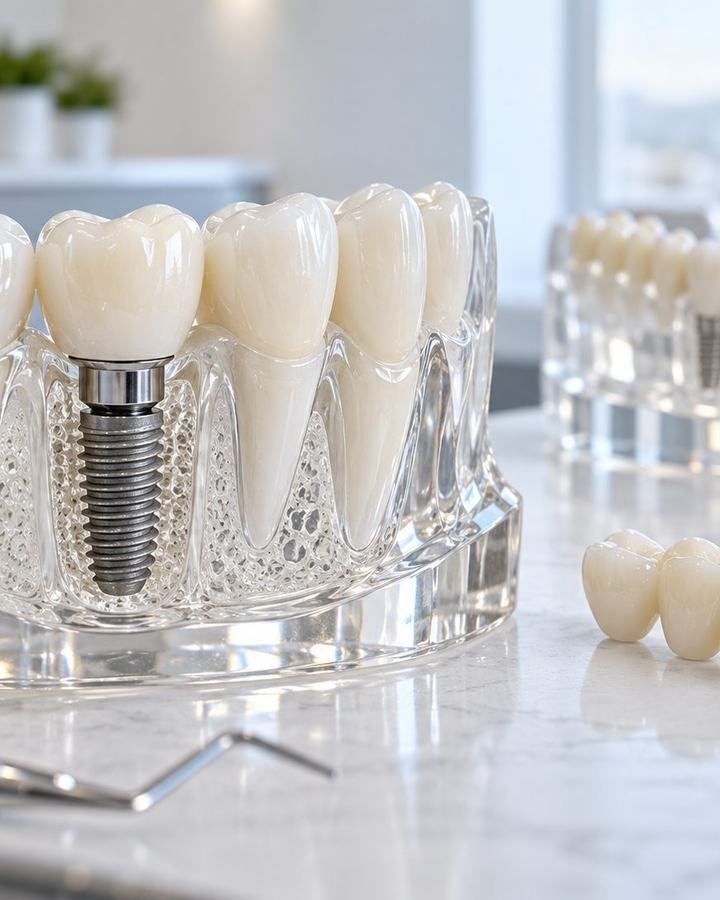
Why is it not done in every case?
The implant needs to achieve sufficient primary stability during placement, the bone and soft tissue need to be suitable, the prosthesis needs to be loaded in a controlled way, and the patient needs to be able to follow the instructions. In some situations waiting for biological healing without loading is a safer option.
The difference between a temporary tooth and a permanent tooth
A prosthesis made in the early period is most often temporary. After healing is complete and the tissues have stabilised, a new impression and design can be made for the definitive prosthesis.
Frequently asked questions
Is immediat (immediate) loading a better treatment?
Not always. Its advantage is that in a suitable patient it can reduce the time spent without teeth; however, if the biological and mechanical conditions are not suitable, the conventional healing protocol may be more appropriate.
Can it be said in advance for certain that a tooth will be made on the same day?
A high probability can be estimated with imaging and examination; even so, the stability obtained during implant placement may affect the final decision.
Are immediat implant and immediat loading the same?
No. One refers to placing the implant in the same session as the extraction, the other to attaching an early prosthesis on top of the implant.
Treatment duration
In cases where early loading can be carried out, a temporary prosthesis may be planned within a short time; the definitive prosthesis is prepared after healing is complete and the tissues have stabilised.
When it may not be suitable
Where sufficient primary stability cannot be achieved, where the bone or soft tissue is not suitable, where the prosthesis cannot be loaded in a controlled way, or where the patient's compliance with instructions is limited, it is safer to wait for biological healing without loading.