
Implants and Oral Surgery
Dental Implant
A dental implant is a structure, usually made of titanium, that is placed in the jawbone to take the place of the root of a missing tooth and allows a prosthesis to be built on top of it.
Medical review: Dr. Taylan Akça. Last updated: Aug. 29, 2026.
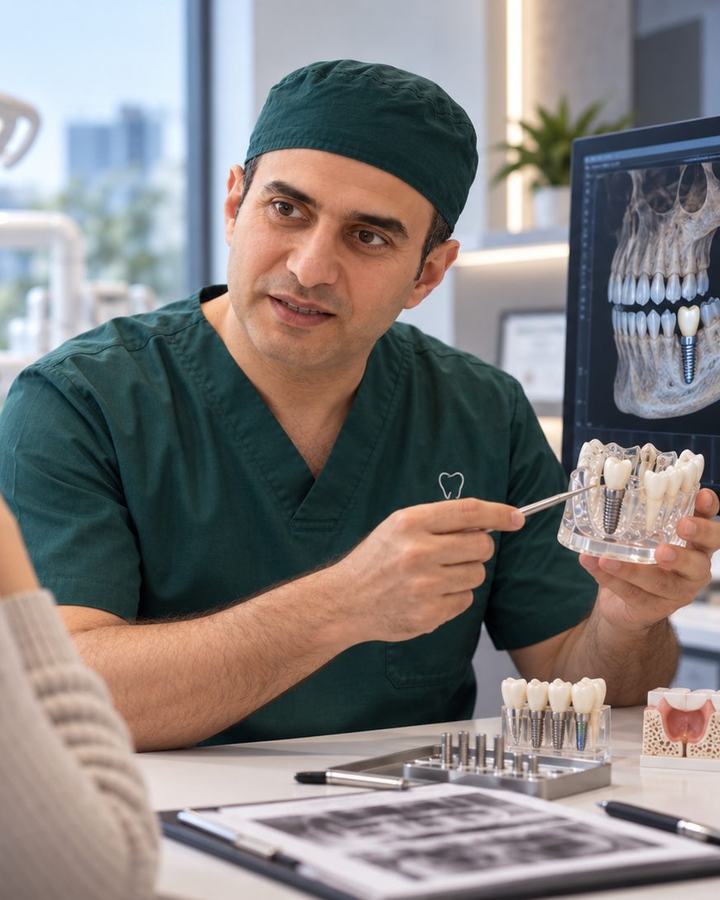
What is a dental implant?
The implant itself is not the tooth you see in the mouth; it is the supporting part that sits within the bone. The crown, bridge or prosthesis that provides chewing function and appearance is attached to the implant afterwards.
When might it be considered?
- A single missing tooth
- More than one missing tooth
- Situations where all of the teeth in the posterior region are missing
- Full edentulism
- Some situations where the retention of a removable prosthesis is to be increased
How is planning carried out?
Implant planning considers not only the area where the gap is, but also gum health, the remaining teeth, the bite, bone volume, the relevant anatomical structures, general health, smoking, oral hygiene and the design of the prosthesis to be made, all together. A panoramic X-ray or three-dimensional CBCT imaging may be requested where needed.
Single tooth, multiple gaps and full edentulism
Where the neighbouring teeth are suitable, a single crown on a single implant may be considered; bridge treatment can also be an alternative. With multiple gaps an implant is not necessarily required for every missing tooth; implant-supported bridges may be planned with a suitable distribution of implants. In a fully edentulous jaw, fixed or removable implant-supported prosthesis options are planned taking into account the available bone, anatomical limits, cleansability, the prosthetic space, the patient's expectations and long-term care.
Risks and aftercare
Implant surgery can carry risks such as bleeding, infection, healing problems, proximity to anatomical structures such as nerves, and failure of the implant to integrate with the bone. After the implant is placed, the health of the gum and bone tissues also needs to be maintained. Implants do not decay; however, inflammation and bone loss can develop in the tissues around them.
Frequently asked questions
What is the success rate of a dental implant?
Although scientifically high success rates are reported for implant treatment, it is not appropriate to use a single percentage as a guarantee for every patient. Success depends on many factors, including bone, the site, systemic health, smoking, oral hygiene, surgical/prosthetic planning and follow-up.
Can an implant be placed in anyone?
Many adults can be assessed for an implant; however, situations such as uncontrolled systemic disease, certain medications, a history of radiotherapy to the head and neck region, active periodontal disease or inadequate oral hygiene may affect the plan. The decision is made by an individual examination.
If there is not enough bone, can an implant not be placed?
Not always. In some cases a suitable environment for an implant can be created with bone augmentation, grafting or surgical procedures directed at the sinus region. In some cases a different implant/prosthesis option may be more appropriate.
Is an implant painful?
The procedure is carried out under local anaesthesia and pain control during the procedure is the aim. Afterwards, pain, tenderness or swelling may be seen for a few days; the expected course and the medications to be used are explained individually before the procedure.
Does an implant last a lifetime?
It is not appropriate to give a lifetime guarantee for an implant. Long-term success is related to oral hygiene, regular check-ups, the health of the surrounding tissues, mechanical loads and general health.
Does smoking affect an implant?
Smoking can adversely affect wound healing and the health of the tissues around the implant and can increase the risk of complications. The amount smoked and a plan to stop or reduce should be discussed before treatment.
Treatment duration
The time needed varies with bone quality, any additional surgical procedures (grafting, sinus tabanı yükseltme / sinus lift), the jaw and the system used. In the conventional approach there is a waiting period for the implant to integrate with the bone; in suitable cases, early / immediat (immediate) temporary prosthesis options may be assessed.
When it may not be suitable
Suitability is determined by an individual examination. Situations such as uncontrolled systemic disease, certain medications, active infection, inadequate oral hygiene or a history of radiotherapy to the head and neck region may affect the plan.