
Orthodontics and Clear Aligners
Clear Aligner Treatment
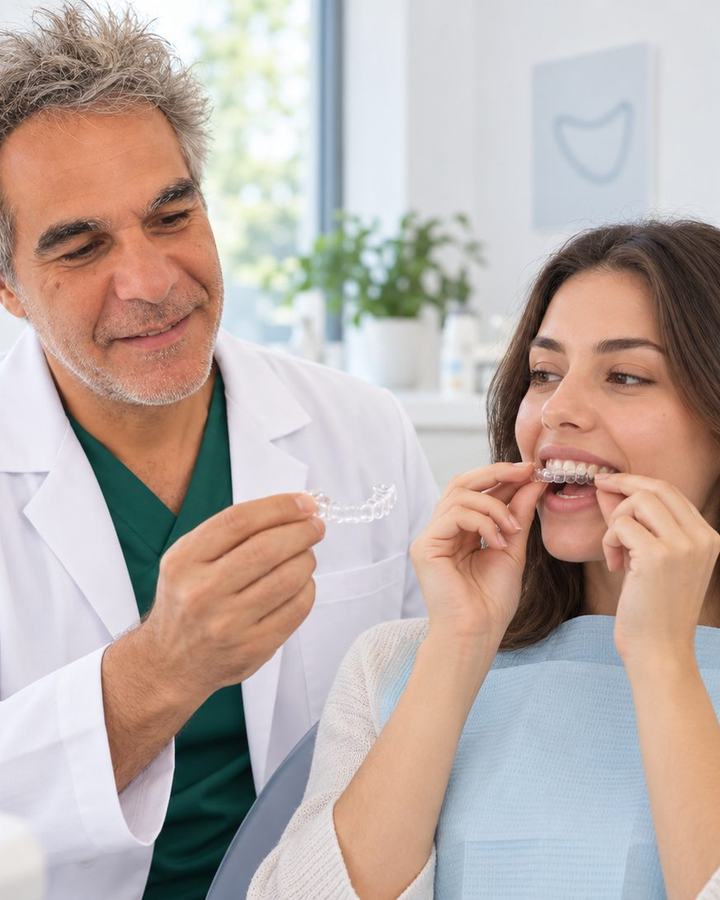
In clear aligner treatment the teeth are moved in a controlled way by means of a series of custom aligners. Invisalign is one of the clear aligner systems. The treatment requires a separate orthodontic assessment and planning.
Medical review: Dr. Çağrı Dinçyürek, Orthodontist. Last updated: Aug. 29, 2026.
Digital planning
A three-dimensional record of the teeth can be taken with an intraoral scan. Planning software helps to visualise the stages of the intended tooth movements. A digital simulation provides a projection but is not an exact guarantee of the biological response; check-ups and, where needed, refinement stages may be carried out during treatment.
Who is it suitable for?
Many mild to moderate and some advanced orthodontic problems can be treated with clear aligners. However, it may not be the best method for every case. The type of tooth movement, the periodontal condition, patient compliance and jaw relationships should be assessed.
Frequently asked questions
Do clear aligners and braces give the same result?
In many cases both methods may be options; for some movements fixed orthodontics may be more predictable. The decision is made after an orthodontic assessment.
How many hours a day are the aligners worn?
Most protocols require a high daily wear time. The precise wear time is specified for the individual after an orthodontic assessment.
Are they removed when eating?
The aligners are generally removed while eating and put back in after oral hygiene.
Is a retainer needed at the end of treatment?
Yes, after orthodontic treatment a retention plan is needed to maintain the new position of the teeth.
Are clear aligners used in children?
There are various clear aligner protocols suited to age and the stage of dentition; suitability is determined by an orthodontic assessment.
Treatment duration
The wear time and the total treatment time vary with the case and are specified for the individual after an orthodontic assessment. A retention (retainer) plan is needed after treatment.
When it may not be suitable
A clear aligner is not the most suitable method for every case. The type of tooth movement, the periodontal condition, patient compliance and jaw relationships should be assessed; for some movements fixed orthodontics may be more predictable.